If you’re a Black woman in the Boston area dealing with thinning edges, a widening part, or a crown that shows more scalp than it used to, you already know the real issue isn’t just hair. It’s confidence. It’s the constant “angle checking” in mirrors, avoiding bright lighting, and relying on fibers, sprays, wigs, or styles that hide the problem—but don’t solve it.
The good news: there’s a solution that looks natural, doesn’t require surgery, and can dramatically improve the appearance of density along the hairline and crown.
It’s called Scalp Micropigmentation (SMP)—and when done correctly, it blends beautifully on melanin-rich skin and works extremely well for female thinning.
A question I hear all the time: “Are you familiar working on women of color?”
Yes. And I’m not guessing—I’m speaking from real volume and experience.
At Scalp Designs, roughly 30% of our clients are African American, Haitian, and Spanish women who come in for hairline, temple, and crown thinning. So, if you’re worried about whether SMP will look natural on your skin tone, you’re in the right place.
We work with many women who have experienced significant hair loss but still want to wear their hair longer—not the shaved-head look. A common goal is keeping their current style or wearing a wig, while improving the areas that show most: the hairline, temples, and sides. That’s exactly what we do.
And it’s not one-size-fits-all. Whether your concern is edges, crown thinning, alopecia, traction-related loss, or overall density, we build a plan around your unique situation—because every client’s pattern, goals, and lifestyle are different.
Why this matters (and why many clinics can’t deliver this result)
Women’s SMP on melanin-rich skin takes more than “general SMP experience.” It requires:
-
precise tone matching for darker skin
-
softer, layered impressions so it never looks heavy or “inked”
-
an understanding of female thinning patterns (edges, part, crown)
-
a conservative approach that stays natural as you live your life (different lighting, different hairstyles, different lengths)
A lot of clinics can do basic SMP. Very few are truly specialized in female density work—especially for Black and Spanish women.
The bottom line
If you’re a Black, Haitian, or Spanish woman in the Boston area dealing with thinning edges, a widening part, or crown show-through, Scalp Designs is built for this. We don’t “also do women.” **We specialize in women—**and our results reflect that.
Why thinning edges and hairlines happen for many Black women
Hairline thinning isn’t always one single cause. In the Boston area, I see these patterns most often:
-
Traction alopecia (tension from braids, sew-ins, ponytails, tight styles, glued lace fronts)
-
Postpartum shedding (after pregnancy hormone shifts)
-
Stress-related shedding
-
Thinning at the part line or crown (often genetic or hormonal)
-
Heat/chemical history that weakened the hairline over time
No matter the cause, the end result is usually the same: your scalp becomes more visible—especially around the temples/edges and crown.
What scalp micropigmentation does for thinning edges and crowns
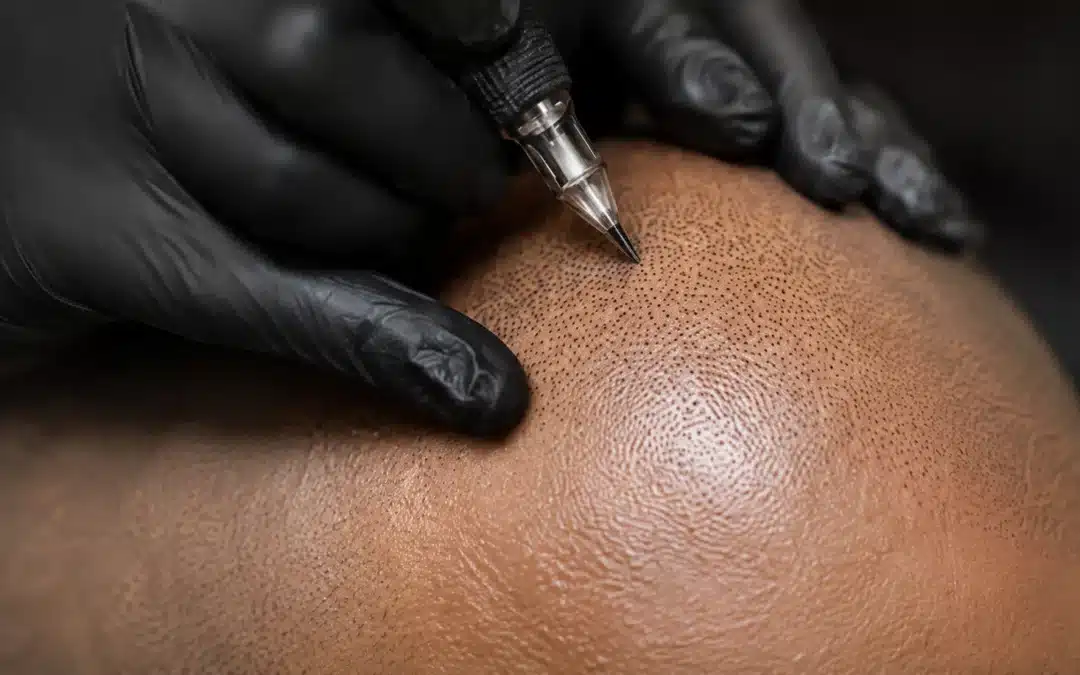
SMP is a cosmetic density treatment that places tiny, hair-follicle-like impressions in the scalp. The goal isn’t to “tattoo a hairline.” The goal is to reduce scalp show-through, so your hairline and part look fuller.
For women, SMP is commonly used for:
-
Thinning edges/temples
-
Sparse hairline
-
Wide part line
-
Crown thinning
-
Overall density improvement where hair is still present but visibly thin
Think of it like “makeup that doesn’t wash off”—but subtle, layered, and done specifically to match your skin tone.
“Will it look natural on dark skin?”
This is the #1 question—and it should be.
When SMP looks unnatural, it’s almost always because of poor technique: dots too large, too dark, too sharp, or placed without proper layering. For Black women, the key is precision:
-
Proper tone matching for melanin-rich skin
-
Softer, natural impressions (not heavy, solid ink)
-
Correct spacing and density so it blends with your real hair
-
A realistic, feminine hairline approach (not a harsh “line”)
Done correctly, SMP should look like you simply have more density, especially in natural light and up close.
The process at Scalp Designs: what to expect
Most women complete SMP in 3 sessions.
Session plan (typical)
-
Session 1: Build the base layer (soft foundation)
-
Session 2: Add density and depth
-
Session 3: Final refinement for a fully blended result
Sessions are spaced out to allow healing and to ensure the result stays natural, not overdone.
Aftercare (simple, but important)
For the first few days after each session, you’ll typically avoid:
-
Shampooing
-
Heavy sweating/saunas
-
Swimming
After that, it’s normal life—just with more confidence when you see your hairline and crown.
Who is SMP best for?
SMP is ideal if:
-
You have visible thinning but still have hair present
-
You want a natural-looking density effect
-
You’re tired of fibers/sprays being your “plan A”
-
You want a solution that works with wigs or natural hair (not against them)
If your hairline is completely bald from long-term traction, SMP can still help cosmetically, but your plan needs to be personalized so the result stays realistic.
Serving Boston and surrounding towns
Scalp Designs works with clients throughout:
Boston, Milton, Quincy, Dorchester, Roxbury, Mattapan, Hyde Park, Brockton, and Randolph—and anywhere within driving distance of Greater Boston.
If you’ve been thinking about doing something for your hairline, the fastest next step is a quick consultation so I can:
-
evaluate your thinning pattern
-
recommend the best approach for edges vs crown vs part
-
give you an exact plan and price range
Book a consultation
If you’re ready to explore SMP as a solution for thinning edges or crown thinning, reach out:
Scalp Designs
Website: www.scalpdesigns.com
Phone: 508-978-3479
Email: johnscalpdesigns@gmail.com